February 24, 2026
Driverless delivery - advantages and future prospects
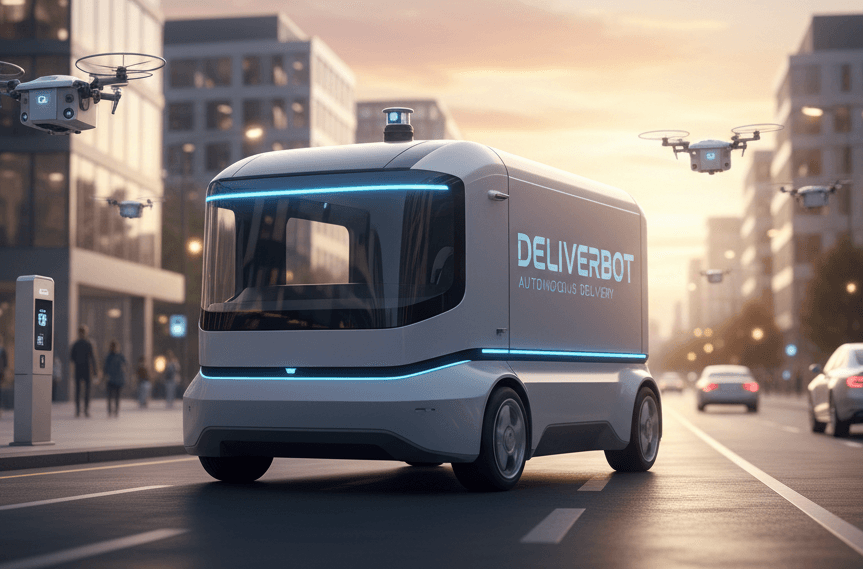
Driverless delivery is increasingly developing from a concept for the future into a realistic solution for current challenges in logistics. Rising costs, a shortage of drivers, increasing delivery traffic in cities and stricter environmental regulations are driving companies to break new ground. Autonomous delivery vehicles offer great potential here - economically, ecologically and organizationally.
Economic benefits for logistics and retail
One of the biggest advantages of driverless delivery concepts is their cost-effectiveness. Traditional delivery processes are heavily dependent on personnel. Drivers account for a significant proportion of running costs, while wage and ancillary costs and the minimum wage are constantly rising.
Autonomous delivery vehicles significantly reduce this cost block. Although humans are not completely eliminated from the process, one operator can monitor several vehicles at the same time. This significantly reduces the costs per delivery. Vehicles can also be deployed more efficiently as they are available almost continuously and do not require traditional shift or break times.
For fleet operators, retailers and logistics service providers in particular, driverless delivery opens up new scope for handling deliveries economically, even with increasing volumes.
Relieving the driver shortage
The driver shortage is one of the biggest structural challenges facing the industry. It is becoming increasingly difficult to find qualified personnel, especially on the last mile. Driverless delivery vehicles can take over standardized, recurring routes and thus relieve human drivers in a targeted manner.
People remain important - for example for planning, monitoring, maintenance or complex special cases. However, monotonous journeys with many stops can increasingly be automated. This stabilizes supply chains and reduces dependence on the labour market.
Sustainability and electromobility
Driverless delivery vehicles are almost exclusively electric. They therefore make an important contribution to reducing CO₂ emissions, noise and air pollutants in cities. Compact autonomous vehicles in particular require less energy and space than conventional delivery vans.
In conjunction with intelligent route planning, journeys can be bundled, empty runs avoided and traffic flows equalized. This has a positive effect on the quality of life in urban areas.
Safety and reliability
Autonomous systems drive according to the rules, do not tire and work constantly. Modern sensor technology detects obstacles, road users and hazards at an early stage. In combination with remote monitoring, operational safety is also increased. Experience has also shown that delivery with a robot is quicker.
An important advantage: risks for drivers are eliminated. Accidents, fatigue or stress situations are reduced. Driverless delivery therefore not only increases efficiency, but also safety in the delivery process.
Future prospects for autonomous delivery
Driverless deliveries will gradually become established over the coming years. Initially in clearly defined areas such as urban districts, business parks, campus areas or suburbs. Routes there are manageable and easy to plan.
In the long term, autonomous delivery vehicles will be an integral part of smart cities. Different vehicle types - from autonomous vans to compact delivery vehicles - will work together in a coordinated manner. Driverless delivery will not replace people, but will make logistics more efficient, sustainable and resilient.
You might also be interested in